Crédito: Gabriel Paulino
IMDS makes technical visit to the Government of the State of Piauí
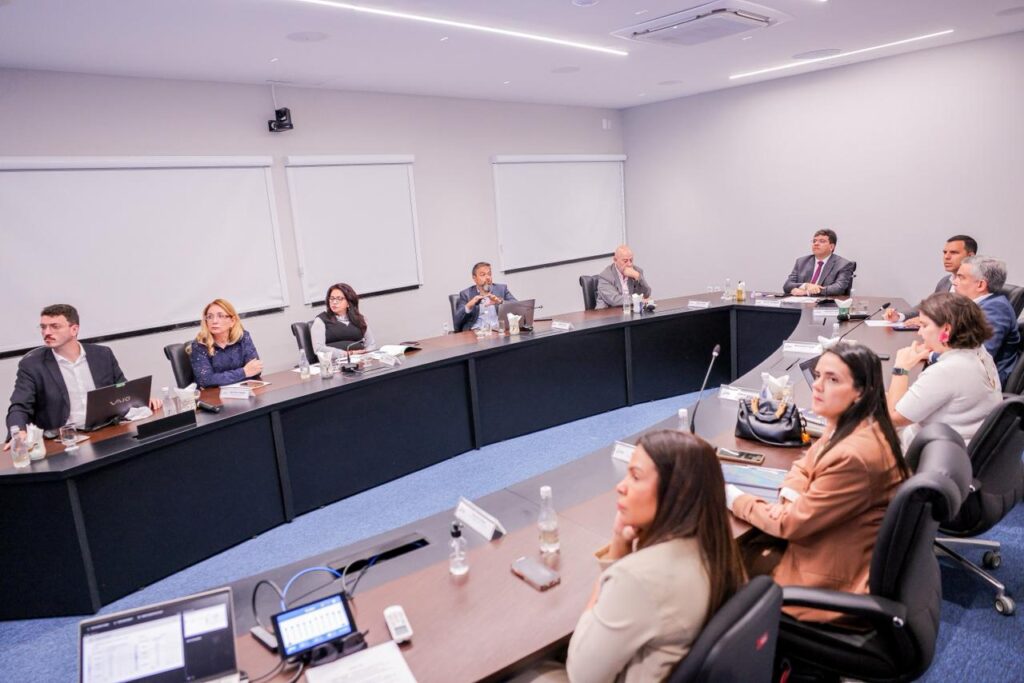
In early April, IMDS carried out the second technical visit to the Government of the State of Piauí. The meeting aimed to present the results of the impact assessment of the policy of expansion of full-time education in the state. In addition, the methodology of the Failure Predictor, a predictive model developed by IMDS to identify students with insufficient performance and a higher risk of failure, was also shared.
During the visit, a technical meeting was initially held with the teams of the Secretariat of Planning (SEPLAN – PI) and the Secretariat of Education (SEDUC – PI), with the presence of their respective secretaries, Washington Bonfim and Rodrigo Torres. Then, the IMDS team, represented by the CEO, Paulo Tafner, and data scientist Mônica Bahia, together with the partner Samuel Franco, from Oppen Social, presented the results of the impact assessment of the expansion of full-time education in the state and the IMDS Failure Predictor in a meeting with the governor of Piauí, Rafael Fonteles.
Tafner highlights the importance of “establishing an exchange with the technical team”, which, according to the economist, can be even richer and more productive when it happens in person. The meetings made it possible to discuss the main findings of the study and explore opportunities to deepen the partnership signed by the Technical Cooperation Agreement between IMDS and the Government of the State of Piauí. “The visit boosted new avenues/fronts of collaboration with the state”, says Mônica Bahia. Among the developments discussed is the expansion of impact assessment to more recent data, with the inclusion of data from 2025, in addition to an approximation with the initiative of the Federal University of Piauí (UFPI), which develops a model for predicting school abandonment at the high school level.

Credit: Gabriel Paulino
Impact assessment of the expansion of full-time education in the state of Piauí
Since 2023, the state of Piauí has undergone rapid expansion of full-time education. A pioneering experience. By 2022, full-time had been introduced in a set of 96 schools, in a gradual process that began in 2009. In 2023, reflecting the search for universalization of the model, 104 schools were converted. In 2024, there were 152. The IMDS institutional report “Impact Assessment of Full-Time High School in Piauí” presents the results of a survey that estimates the causal effect of this experience on school educational indicators.
The analysis was based, first, on an in-depth study of the components of the full-time school model in the state, through interviews with public managers linked to recent expansion efforts. In the next stage, a longitudinal database was built for the period from 2017 to 2024, in partnership with SEPLAN. The database gathers information on the year of conversion of each school in the state network to the full-time model, as well as learning indicators, such as scores in standardized exams of the state network (Portuguese Language and Mathematics) and school performance indicators, such as abandonment and approval rates.
The construction of this base allowed the use of evaluation methods to identify and estimate the causal impact of the recent expansion of the model. The research presents evidence that, since 2023, conversion has had significant positive impacts on schools adapted to the format. In particular, adherence to the model reduced the share of students with below-basic performance in Mathematics, by 2.1 percentage points in the 1st grade and by 2.4 percentage points in the 2nd grade, on average. The share of students with below-basic performance in Portuguese in the 2nd grade also fell, by 2.6 percentage points. The school performance data suggest that these improvements occurred without systematically changing abandonment or failure rates.
Paulo Tafner emphasizes the relevance of impact assessment of full-time education expansion in the state of Piauí: “the study can guide other subnational entities – states and municipalities – to implement the policy in the best way”. Projects like this are essential for the improvement of public policies. Therefore, IMDS will continue with its efforts to foster the construction, implementation and evaluation of evidence-based public policies.
